



I’ve been watching the rollout of ETIAS with interest. This new travel authorization is changing the way people visit Europe. But as with nearly all the best-laid plans of EU bureaucrats, it hasn’t gone completely smoothly.
Travel eSIMs you may like:
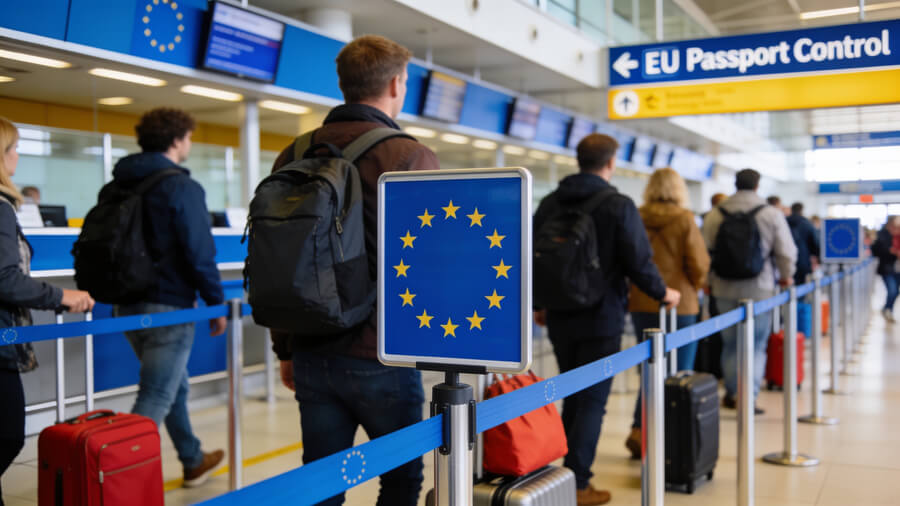
ETIAS is a travel requirement that will apply to millions of travellers to Europe in the future. Let’s take a look at how it works and what it means for Australians so you can factor it into your travel plans.
What is ETIAS?
It might sound like a hero from Greek mythology, but ETIAS is actually an acronym for the European Travel Information and Authorisation System.
Originally scheduled to launch in 2020, it was pushed back to 2021, then 2022, then every subsequent year after that. The current projection is that it will be launched in 2027, but given the delays it’s already suffered, let’s wait and see.
Fundamentally, it operates like Australia’s Electronic Travel Authority (ETA), the United States’ Electronic System for Travel Authorization (ESTA), and several other electronic travel authorizations that have been brought in over recent years.
The goal of these systems is to control immigration. ETIAS applies only to visa-free travellers to Europe, including Australian passport holders, and it prescreens these visitors to make sure they’re not a security or immigration risk.
It’s Not A Visa
Although it can seem like one, ETIAS is not a visa. It doesn’t give you any rights to live or work in Europe, and having one doesn’t mean you’ll be allowed in.
But once the system is implemented, not having one may well be grounds for being denied entry to Europe. In fact, based on how other travel authorizations work around the world, you probably won’t even be allowed on the plane.
Who Needs ETIAS?
Once the system is established, travellers from countries that have visa-free arrangements with the EU will need to apply for ETIAS clearance before they arrive. That includes Australian citizens.
Specifically, ETIAS is required to visit the Schengen area. Note that this is not exactly the same as the EU, as several non-EU countries are within the Schengen area, and some EU countries, like Cyprus and Ireland, are outside it.
It does cover popular areas like France, Spain, Italy, Germany, the Netherlands, Portugal, and others. But make sure you know whether the new rules apply to you, depending on where you want to go.
The Application Process
Right now (mid-2026), the system is not yet up and running, so applications aren’t being accepted. That means that currently, Australians can travel visa-free in Europe like they always have.
Once the system is ready, you’ll need to apply for authorization before you arrive in Europe.
Applications will be handled online or through an app. You’ll need a valid travel document, such as a passport. Your passport should not expire in less than three months, and it should be no older than 10 years.
It also needs to be a biometric passport, which Australian passports almost always are.
During the application, you will be asked for personal information including:
- your first and last name
- your date and place of birth
- your nationality
- your home address
- your parent’s first names
- your email address and phone number
- your passport number and expiry date
- details about your level of education and your job
- details about your intended travel within Europe
- details of any criminal convictions or any times you have been asked to leave any country in the world.
Make sure you have a payment card too, as there’ll be a €20 application fee.
I’ve filled out travel authorizations like this before for other countries, and they’re usually pretty straightforward. Just make sure you have your information handy, ideally with your passport in front of you, so you can double-check the information you provide.
If it doesn’t match what the airline staff sees when you go to board your flight, you could face delays or even not being allowed to board.
FAQs
Your ETIAS authorization will normally be valid for three years. However, it's linked to your passport, and it expires when your passport does. If you get a new passport, you'll also need to reapply for ETIAS authorization to reenter Europe again.
No. ETIAS authorization covers you for every trip you take to Europe within the three-year validity period, or as long as your passport lasts. You can take as many European trips as you want, but make sure you stick to the rule of only spending 90 out of every 180 days in the Schengen area.
No. You still only get 90 out of 180 days to stay in Schengen visa-free. If you want more than that, you'll need to apply for a visa. ETIAS simply authorizes you to travel to Europe in the first place. It does not give you permission to enter, and certainly doesn't change the existing rule on the length of stay.
Without ETIAS authorization, you won't be allowed to travel to Europe. Chances are, you won't even be allowed to board the flight to get there. ETIAS refusal is not a travel ban. It just means you won't be allowed to travel this way, at this time. If your ETIAS application is refused, you will be emailed with the reason why, and there's a process to appeal the decision. If the authorization is still refused, you can still apply for a traditional visa.
Yes. Every individual travelling needs their own authorization. Children under the age of 18 don't have to pay the fee, but they will still need the authorization. Basically, if you have a passport, you need ETIAS.
Travel eSIMs you may like:
Written by
Ryan Frawley
Travel writer and serial border crosser.
I've visited more than 30 countries so far, which sounds impressive until you see how long my travel wish list still is. When I'm not chasing cheap flights, figuring out eSIMs, or getting lost in places I can't properly pronounce, I'm usually writing about travel, remote work, and how to make both a little easier.
If you've ever searched "Can I work remotely from there?" at 2 a.m., we're probably on the same wavelength.


Get amongst it
Join the community
We will reach out when we launch new products, about our sustainability projects, specials, new innovations or maybe even cool sh*t we think is inbox worthy.


